

How Much Can You Expect to Pay for a Home Inspection in PA?
Purchasing a home is one of the biggest financial decisions you’ll ever make, and it’s filled with plenty of moving parts.
While closing costs can add up to over a dozen additional fees, many of these services, such as title searches and appraisals, are absolutely essential.
It can be tempting for many homeowners to try to minimize these costs by whatever means possible, especially for services they pay out of pocket, such as the home inspection.
However, the return on investment (ROI) for a home inspection that costs a few hundred dollars can save you on repairs, potentially totaling tens of thousands of dollars, which is astronomical.
Whether you’re shopping for home improvements amongst providers in Pennsylvania or are curious how much you can expect to pay when you make an offer on a home, this guide will help you understand the costs and process of a home inspection in Pennsylvania.
Average Cost of a Home Inspection in Pennsylvania
In Pennsylvania, the typical cost of a standard home inspection begins around $550. However, this figure depends on several factors, including:
- Size of the Home: Larger homes take more time to inspect and typically have more systems, more square footage, and more complex layouts. Most home inspectors charge based on square footage. For example:
- Homes between 1,500–2,500 sq ft: ~$550
- Homes over 3,000 sq ft: ~$700+
- Homes between 1,500–2,500 sq ft: ~$550
- Age of the Home: Older homes may require a more detailed inspection because outdated wiring, plumbing, or building practices may not meet modern codes. Inspectors may also spend more time documenting wear and tear in historic or century-old homes, which can bump up the cost.
- Location and Travel: In rural areas, inspectors may charge a travel fee, especially if you’re located far from their usual service area.
- Additional Services: Many inspectors offer add-on services for an extra fee. These can include:
- Radon Testing: $175–$270
- Mold Testing: $400–$600
- Termite Inspection (Wood-Destroying Insect Report): $150–$200
- Septic Inspection: $300–$450
- Water Testing: $175–$275
- Radon Testing: $175–$270
If your home inspector doesn’t offer these services directly, they may refer you to third-party specialists.
What Is a Home Inspection Necessary?
Before discussing the cost of a home inspection, let’s first explore why a home inspection matters to buyers and sellers.
A home inspection visually examines a home’s physical structure and mechanical systems, from the roof to the foundation. The purpose of the inspection is to identify any existing or potential issues that could affect the home’s safety, livability, or value. Home inspectors typically check for issues related to:
- Structural elements (foundation, roof, walls)
- Heating and cooling systems
- Plumbing and electrical systems
- Interior and exterior conditions
- Attic and basement
- Appliances and ventilation
Once completed, the inspector provides a detailed report outlining any problems, safety concerns, or needed repairs.
Not only is this report essential for your safety and peace of mind, but it can be a powerful negotiating tool, especially if you can avoid the cost of any repairs. According to a survey from Porch.com, the average homeowner reduced the final price of their home by $14,000 after negotiating using a home inspection report.
To determine the ROI or savings you can achieve from a home inspection report, we need to compare it to the average cost of a home inspection in Pennsylvania.
Is a Home Inspection Worth the Cost?
While the upfront cost of a home inspection might feel like just another expense in the home-buying process, it can save you a substantial fortune down the road. If the inspection uncovers major defects, such as foundation cracks, mold damage, or roof leaks, you may be able to renegotiate the sale price, ask for repairs, or even walk away from the deal.
In competitive markets, especially around Northeast Pennsylvania, where there is a housing shortage, some buyers are tempted to waive the inspection to make their offer more appealing. However, this is an ill-advised move as no house is free of defects, whether it’s brand new or one hundred years old.
What to Look for in a PA Home Inspector
Finding the right inspector can quickly justify the price you pay for an inspection.
Pennsylvania doesn’t require home inspectors to be licensed at the state level. Still, they must be members of a national home inspection association such as ASHI (American Society of Home Inspectors) or InterNACHI (International Association of Certified Home Inspectors). These organizations require members to complete training, adhere to professional standards, and carry liability insurance.
When choosing an inspector, look for the following characteristics:
- Experience: Especially with homes like the one you’re purchasing (e.g., historic, rural, or multifamily).
- Certifications: Membership in reputable organizations, additional certifications in mold or radon, etc.
- Sample Reports: A good inspector will share a sample report so you know what level of detail to expect.
- References or Reviews: Online reviews, real estate agent referrals, and direct testimonials can provide insight.
Who Pays for the Home Inspection?
Many first-time home buyers tend to ask whether they are responsible for the inspection or the seller.
Typically, the buyer pays for the home inspection, since it’s intended to protect their interests. However, in some cases, such as pre-listing inspections, sellers may pay for an inspection to identify and address issues before putting the home on the market.
Skipping an Inspection Could Cost You Money
A few hundred dollars for a home inspection may feel like a speed bump in an already expensive process, but it’s one of the smartest investments you can make in Pennsylvania’s housing market. Whether buying a Victorian home in Scranton, a new build in Clarks Summit, or a cabin in the Poconos, a home inspection gives you leverage, knowledge, and peace of mind to help you make the right decision.
FAQs
Are home inspections required in Pennsylvania?
No, but they are highly recommended and often written into the home purchase agreement.
How long does a home inspection take?
Most inspections take between 2 and 4 hours, depending on the size and complexity of the home.
Can I be present during the inspection?
Yes, and it’s encouraged. You’ll learn a lot about the property and can ask questions directly.

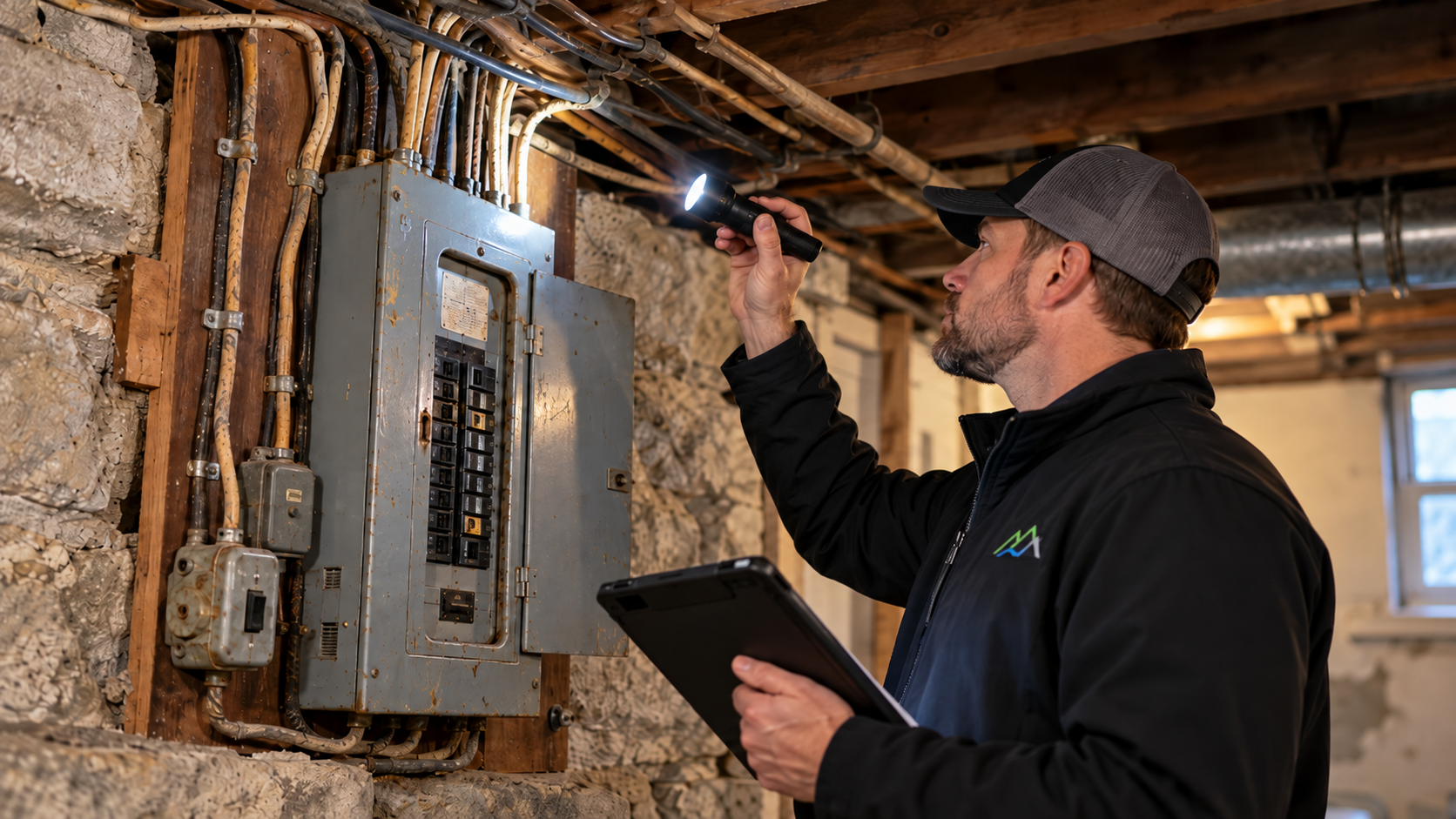
Is Your Old Electrical Wiring Safe? 6 Signs in NEPA
The six warning signs of unsafe wiring are flickering or dimming lights, breakers that trip often, a burning smell or discolored outlets, outlets or switches that spark, switch plates that feel warm, and rodent damage to wires. Any one of them in an older Northeastern Pennsylvania home is reason to have the electrical system evaluated, and most buyers first learn about the problem during a home inspection.
The timing matters right now. Electrical problems surface in heating season, when space heaters, electric blankets, and holiday lighting push old circuits past what they were built to carry, and national fire data show home electrical fires peak in winter. This guide explains why older NEPA homes carry higher electrical risk, the six signs, why fall exposes them, what an inspection checks versus what needs an electrician, and the insurance and financing problems outdated wiring creates.
Why do older NEPA homes carry higher electrical risk?
Much of the region’s housing was built between the coal boom and the 1960s, which means wiring methods that were standard then are hazards now.
- Knob-and-tube wiring. InterNACHI notes that knob-and-tube was the standard wiring method from about 1880 to the 1940s. It has no ground, its insulation grows brittle with age, and it was designed to shed heat into open air, so blown-in attic insulation traps heat around it. Unsafe amateur splices are also far more common with knob-and-tube than with modern wiring.
- Aluminum branch wiring. Installed in many homes in the 1960s and 1970s when copper prices spiked. Aluminum expands and loosens at connections, which can overheat. InterNACHI’s standards call for inspectors to report solid aluminum branch-circuit wiring whenever it is observed.
- Fuse panels and undersized service. A 60-amp fuse panel was adequate for a 1940s household. Oversized fuses installed to stop nuisance blowing let wires carry more current than they were made for.
- Ungrounded two-prong outlets and missing GFCI protection. Common in the kitchens, baths, basements, and garages of older homes, where water raises the shock risk.
The fire data back this up. NFPA reports that electrical distribution and lighting equipment were involved in an estimated 32,620 home fires per year from 2015 to 2019, causing an average of 430 deaths and 1,070 injuries annually, with wiring and related equipment accounting for the majority of those fires. Wiring is one of several age-related issues covered in buying an older home in NEPA, 9 common issues to look for.
The 6 signs your wiring is not safe
Each sign below stands on its own. One is enough to call for an evaluation, and two or more in the same home mean the system is telling you something.
1. Flickering or dimming lights
A loose bulb is harmless. Lights that dim when an appliance kicks on, or that flicker across several rooms, point to loose connections, an overloaded circuit, or damaged wiring behind the wall. In a home with knob-and-tube or aluminum wiring, treat it as a warning, not a quirk.
2. Breakers that trip or fuses that blow often
Breakers trip to protect the wire. One trip when a space heater and a microwave share a circuit is the system working as designed. Repeated trips on the same circuit mean the load is too high for the wire or something is shorting. Never replace a fuse with a larger one to stop the problem, because that removes the protection.
3. A burning smell or discolored outlets
A faint smell of hot plastic near an outlet, switch, or the panel means insulation is overheating. Brown or black marks on a cover plate mean it already has. Stop using the circuit and call a licensed electrician the same day.
4. Outlets or switches that spark
A small spark when you plug in a device can be normal. Large, loud, or frequent sparks, or sparks with smoke or a smell, indicate a short or damaged wiring inside the box or the wall.
5. Warm outlets or switch plates
Cover plates should be room temperature. A plate that is warm to the touch is passing more current than the connection can handle, usually because a wire has loosened or insulation has melted.
6. Rodent damage
Mice and squirrels chew wire insulation in attics, basements, and wall cavities and leave bare conductors behind. Droppings near the panel or chewed wire in the attic are enough to call for an evaluation, even if nothing else seems wrong.
Why do wiring problems surface in fall under space heaters and winter loads?
Old wiring fails under load, and NEPA homes carry their heaviest electrical load from October through March. A single space heater draws about 1,500 watts, which is most of what a 15-amp circuit can safely carry on its own. Add an electric blanket, a dehumidifier running in a damp basement, and holiday lights, and circuits built for a few lamps run near their limit for hours at a time.
NFPA’s data show the peak months for home electrical fires fall in winter, with December leading, and that the deadliest fires start while people are home and asleep. Space heaters on extension cords add a second risk. NFPA found that cords and plugs are involved in only about one percent of home fires but seven percent of the deaths, with extension cords dominating that category.
That is why fall is the right time to act on any of the six signs, and why a buyer closing on an older home this season should treat electrical findings as first-tier items. Oil and gas heating equipment in these homes brings its own risks, covered in Does a Home Inspection Include the Furnace?.
What a home inspection checks vs. what needs a licensed electrician
A home inspection is a visual evaluation of the readily accessible electrical system under the InterNACHI Standards of Practice. A licensed electrician goes further. The table shows where one ends and the other begins.
| Component | Home inspector | Licensed electrician |
| Service panel | Removes the dead-front cover and inspects for double taps, scorching, improper breakers, and panel type | Performs load calculations, repairs, and panel replacement |
| Wiring type | Reports visible knob-and-tube and solid aluminum branch wiring | Traces circuits, confirms what is live, and prices remediation |
| Outlets and switches | Tests a representative number for power, grounding, polarity, and GFCI function | Repairs, rewires, and adds circuits |
| Visible wiring in attics and basements | Reports damaged insulation, open splices, and rodent damage | Opens walls and replaces runs |
| Hidden wiring inside walls | Not inspected | Evaluated with testing when a problem is suspected |
The inspection tells you what is there and what needs attention. The electrician tells you what it costs. Keep the electrical findings alongside the roof, heating, and plumbing on the Pennsylvania home inspection checklist when you negotiate. Older homes across the Wyoming Valley, including West Pittston, show these systems often.
Insurance and financing issues with outdated wiring
Outdated wiring is a buyer-cost issue even when nothing has failed. InterNACHI notes that many insurance companies refuse to insure homes with knob-and-tube wiring because of the fire risk, and insurers commonly treat fuse panels and aluminum branch wiring with the same caution. Some require remediation before they will bind a policy, others charge more, and a few decline the home outright.
Lenders follow the insurers. A home you cannot insure is a home you cannot finance. If the inspection finds knob-and-tube, aluminum wiring, or a fuse panel, call your insurance agent before the contingency deadline so you can negotiate the remediation cost, or a credit to cover it.
Next steps
If you own an older NEPA home and see any of the six signs, call a licensed electrician now, before heating season loads the circuits. If you are buying, make the electrical findings part of your inspection contingency and get an electrician’s estimate while the clock is running.
FAQs
Is knob-and-tube wiring illegal in Pennsylvania?
No. Existing knob-and-tube is not illegal to have, but InterNACHI notes many insurers refuse to cover homes that have it, and any modification or addition must meet current code. A licensed electrician should evaluate it before you buy or renovate.
Can I add attic insulation over knob-and-tube wiring?
Not without an evaluation. InterNACHI explains that knob-and-tube was designed to dissipate heat into open air, and insulation around it traps heat and creates a fire hazard. Have an electrician assess the wiring before insulating.
Does a home inspection include the electrical system?
Yes. Under InterNACHI standards the inspector inspects the service panel, reports visible knob-and-tube and solid aluminum branch wiring, and tests a representative number of outlets and switches. Wiring hidden inside walls is not inspected.
Are older homes more at risk for electrical fires?
Yes. Older homes are more likely to have outdated wiring, brittle insulation, ungrounded outlets, and circuits that were never designed for modern loads. NFPA data attribute an estimated 32,620 home fires per year to electrical distribution and lighting equipment.
How often should an older home’s electrical system be inspected?
For homes over 30 years old, have the system evaluated every few years, before major renovations, after you purchase, or any time one of the six warning signs appears.

How to Negotiate Repairs After a Home Inspection in PA
After a home inspection in Pennsylvania, you have three options. You can ask the seller for repairs or a credit, accept the home as-is, or walk away. Under the Pennsylvania Association of Realtors Standard Agreement of Sale, all three choices run on a clock, and your home inspection report drives each one.
This guide explains how the PA inspection contingency works, how to sort the report so you ask for the right things, how repairs compare with credits and price reductions, what sellers must disclose, why inspectors do not price repairs, and what a realistic timeline looks like. It is general information rather than legal advice. Your agent and, when needed, a real estate attorney apply it to your contract.
What does the inspection contingency in the PA Agreement of Sale allow?
The inspection contingency sits in Paragraph 13 of PAR’s Standard Agreement for the Sale of Real Estate, known as Form ASR. According to PAR’s own Legal Hotline guidance on the inspection contingency, the buyer has three choices once the inspections are complete. Accept the property. Terminate the agreement. Or present the seller with a Written Corrective Proposal that lists the corrections or credits the buyer wants.
The contingency runs in three timed segments. The inspection contingency period is when you complete your inspections and deliver your decision, with copies of the reports, to the seller. If you submit a corrective proposal, a negotiation period follows, which PAR describes as five days under the standard form. If that period ends with no written agreement, you then choose to accept the property or terminate.
Two deadlines matter most. Your decision and your reports are due by the last day of the contingency period, not on the day of the inspection. And once you submit a corrective proposal, PAR notes that you cannot withdraw it, change it, or terminate until the negotiation period ends. If you miss the contingency deadline and the seller is no longer obligated to negotiate, you give up the right to terminate under this contingency.
How do you sort the report? Safety and structural vs. cosmetic
The report is not a repair list for the seller. It is the home’s full condition, and the fastest way to lose a negotiation is to ask for everything. Sort the findings into tiers before you write a proposal.
| Priority | Typical findings | How to handle it |
| Tier 1. Safety and structural | Active roof leaks, a furnace or boiler that did not operate, knob-and-tube or aluminum wiring, foundation movement, elevated radon, active water intrusion | Always include. Request repair by a licensed contractor or a credit sized to a written estimate. |
| Tier 2. Major systems near end of life | Roof or heating system with little life left, aging water heater, older plumbing or electrical panel | Include when the cost is significant. A credit is often more practical than a seller repair. |
| Tier 3. Deferred maintenance | Clogged gutters, missing GFCI protection, grading that slopes toward the house, failed caulk and seals | Include selectively, usually as a small credit or a grouped request. |
| Tier 4. Cosmetic | Paint, worn flooring, cracked tile, sticking doors | Leave out. These weaken the proposal and are expected in a resale home. |
Lead with Tier 1. A proposal built on documented safety and structural findings is hard for a seller to dismiss. Pull the largest items from the categories on the Pennsylvania home inspection checklist, which are the roof, heating, electrical, plumbing, and water, and let the cosmetic items go.
Repair vs. credit vs. price reduction
A corrective proposal can ask for corrections, credits, or both. PAR’s Form BRI is the document buyers use to deliver that choice. Each option has trade-offs.
| Option | Pros | Cons |
| Seller completes repairs | No cash out of your pocket at closing. The work is done before you move in. | You do not control the contractor or the quality. Rushed work before settlement is common, so require receipts or a re-inspection. |
| Credit at settlement | You choose the contractor and the timing. Simple to document on the settlement sheet. | Lender rules can cap seller credits. You carry the project after closing. |
| Price reduction | Lowers the loan amount and the long-term cost. | Puts less cash in your hand at closing than a credit. Can prompt an appraisal review. |
| Walk away | Removes all of the risk. The deposit is typically returned when you terminate under the contingency. | You lose the home and the cost of the inspection. |
Most buyers in NEPA do best asking the seller to fix true safety items and taking a credit for everything else. Ask your lender early how large a seller credit your loan allows, because that number shapes the proposal. For who typically pays for what in a Pennsylvania transaction, see Does the Buyer or Seller Pay for the Home Inspection?
What must sellers disclose under Pennsylvania’s Seller Disclosure Law?
The Pennsylvania Real Estate Seller Disclosure Law, found at Chapter 73 of Title 68, requires any seller transferring an interest in residential property to disclose known material defects to the buyer by completing a property disclosure statement. The law defines a material defect as a problem with the property that would have a significant adverse impact on its value or that involves an unreasonable risk to people on the property.
The law also sets limits on what matters in a negotiation. A component that is simply at or beyond the end of its normal useful life is not by itself a material defect, so an old roof the seller disclosed as old is not a disclosure violation. The seller must not make statements they know are false or misleading and must not fail to disclose a known material defect, and an agent is liable only with actual knowledge of an undisclosed defect.
Use the disclosure statement alongside the inspection report. When the report finds a defect the seller did not disclose, that is a strong basis for a corrective proposal. When the report confirms something the seller already disclosed, you knew it when you made your offer, and the seller will say so. Questions about a possible violation belong with a real estate attorney.
Why do inspectors not price repairs, and who does?
A home inspector identifies and documents defects. Under the InterNACHI Standards of Practice, the inspection is a visual, non-invasive evaluation that reports the condition of the home’s systems, and it is not a repair estimate. Mountain to Valley does not provide repair quotes, and that separation is what makes the report credible to a seller. The inspector has no stake in the size of the repair.
Pricing comes from licensed contractors. For a Tier 1 roof, heating, or electrical finding, get at least one written estimate during the contingency period, and two for anything large. Attach the estimates to your corrective proposal. A credit request backed by a contractor’s number is far harder to argue with than a round figure.
This is where a clear, photo-based report pays off. Every finding in a Mountain to Valley report carries photos and a plain description, so your agent, the seller, and the contractor are all looking at the same thing. Wood-destroying organism findings, for example, come with the photos a treatment company needs to quote.
What does a realistic negotiation timeline look like?
Timelines depend on the contingency period written into your agreement, so treat this as a sequence rather than a schedule.
- Days 1 to 2. Schedule the inspection and any add-ons such as radon, well water, or septic. Fast availability matters, because the clock started when the agreement was signed.
- Inspection day. Walk the home with the inspector. Ask questions on site while the findings are in front of you.
- Within 24 hours. Review the report with your agent and sort it into tiers.
- Next 2 to 4 days. Get contractor estimates for the Tier 1 and Tier 2 items.
- Before the contingency deadline. Deliver your decision, copies of the reports, and the Written Corrective Proposal on Form BRI.
- Negotiation period. Offers and counteroffers go back and forth. Your proposal stays on the table until this period ends.
- After the negotiation period. Sign the agreed changes. If there is no agreement, accept the property or terminate.
Every one of the 15 reasons you need a home inspection in NEPA comes down to this stretch of days, when the report turns into money and safety. Treat the deadlines as hard.
Turn the report into leverage
A clear report, a sorted proposal, and contractor numbers behind it are what move a seller. Mountain to Valley delivers photo-based reports with fast turnaround so you have time to get estimates before the contingency deadline, and we inspect radon, well water, septic, and wood-destroying organisms on the same visit when you need them.
FAQs
How long do I have to negotiate repairs after a home inspection in Pennsylvania?
Your inspection contingency period is set in the Agreement of Sale, and your decision and reports are due by its last day. If you submit a Written Corrective Proposal, PAR describes a five-day negotiation period under the standard form, after which you accept the property or terminate if there is no agreement.
Can I ask for a credit instead of repairs?
Yes. The Written Corrective Proposal on PAR’s Form BRI can list corrections, credits, or both. Check with your lender first, because loan rules can cap how much a seller is allowed to credit.
Can the seller refuse to make repairs?
Yes. The seller can reject or counter your proposal. If the negotiation period ends without a written agreement, you choose to accept the property as it is or terminate under the contingency.
Does a home inspector give repair costs?
No. The inspector identifies and documents defects. Repair pricing comes from licensed contractors, and attaching their written estimates to your proposal strengthens it.
What if the seller did not disclose a defect the inspection found?
Pennsylvania’s Seller Disclosure Law requires sellers to disclose known material defects. An undisclosed defect supports your corrective proposal, and questions about a possible violation belong with a real estate attorney.