
Yes. If the home you are buying in Northeastern Pennsylvania runs on a private well, test the water before you close. A standard home inspection does not test what comes out of the tap, and Pennsylvania does not test private wells for you.
Here is why that matters. Penn State Extension reports that about half of the private water systems it has tested fail at least one drinking water standard. Many of those problems have no taste, smell, or color. The only way to find them is a lab test.
This guide covers what a well water test checks, why NEPA wells carry extra risk, when to test, and how to read your results.
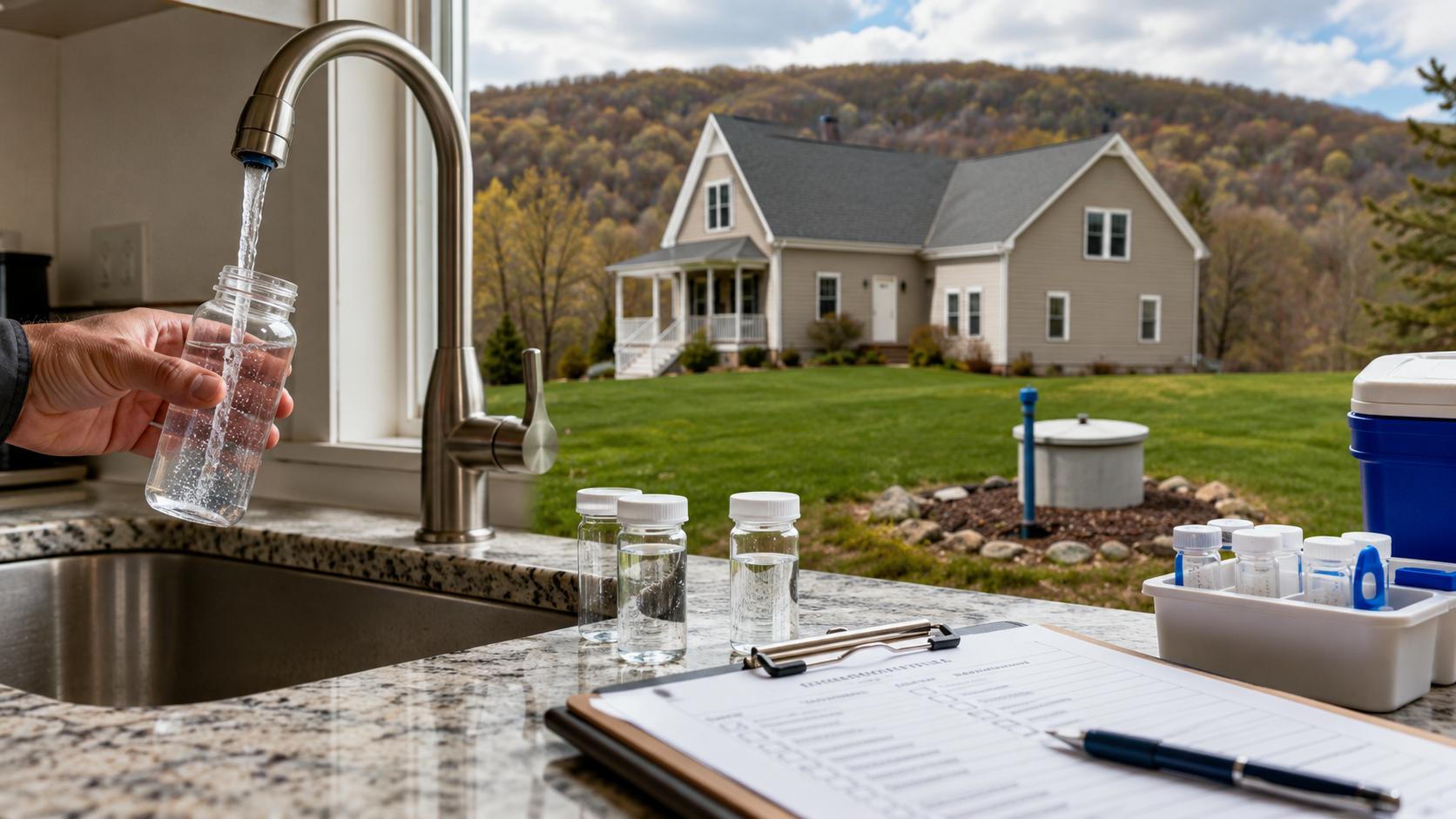
Do you need to test well water before buying a home in NEPA?
Yes, and the reason is simple. A private well is not monitored by any government agency. Penn State Extension makes it clear that testing a private supply is the owner’s voluntary responsibility, and no one routinely tests it for you.
Public water is different. A public utility tests its water on a schedule and reports the results. With a private well, that job passes to you the day you take ownership.
Test before you close, not after. A pre-purchase test tells you the true condition of the water while you can still negotiate repairs, treatment, or price. After closing, any problem and its cost become yours.
Why do private wells in NEPA carry extra risk?
Northeastern Pennsylvania combines rural geology, farmland, and a long mining history. Each of those land uses can affect what ends up in a well.
Penn State Extension links common well pollutants to activities on the land surface, including mining, agriculture, and industry. In a former anthracite region like NEPA, past mining is one of the land uses that warrants a closer look at metals and acidity.
Farm runoff adds another risk. Fertilizer and animal waste raise nitrate levels, which are a specific health concern for infants under six months of age.
Age is a factor too. Pennsylvania has no statewide construction standards for private wells, so an older well may have a cracked casing, a failed surface seal, or a missing cap. Any of those lets surface water and bacteria into the supply.
What does a private well water test check?
A good pre-purchase panel checks for health risks and for problems that damage plumbing. At a minimum, test for the following:
- Total coliform bacteria and E. coli: Coliform signals a pathway for contamination. A positive E. coli result points to human or animal waste and is the more serious finding.
- Nitrates: Common near farmland. High levels are dangerous for infants and for pregnant women.
- Lead: Often comes from older plumbing and fixtures rather than the groundwater itself.
- Arsenic: Occurs naturally in some Pennsylvania groundwater. Penn State Extension notes a health standard of 0.01 mg/L and finds elevated arsenic in roughly 2 to 6 percent of the private supplies it studies.
- pH: Low, acidic water corrodes pipes and can leach lead and copper into your water.
- Total dissolved solids and hardness: These affect taste, staining, and the life of your appliances.
If the property sits near a specific land use, add tests for that risk. A gas station, a former industrial site, or heavy agriculture nearby all call for a wider panel.
Standard home inspection vs. well water testing
A home inspection and a water test answer two different questions. One looks at the house and its systems. The other looks at what you drink.
| Feature | Standard Home Inspection | Private Well Water Test |
|---|---|---|
| What it checks | Roof, structure, and visible systems | Bacteria, nitrates, metals, and water chemistry |
| Water quality | Not included | The entire focus |
| Who performs it | A licensed home inspector | A PA DEP accredited laboratory |
| When to do it | During the inspection period | During the inspection period, before closing |
| What it protects | The condition of the property | The health of your household |
A full picture of the property needs both. You can review the systems an inspection does cover in our Pennsylvania home inspection checklist.
When should you test your well water?
Test at the moments when contamination is most likely. Penn State Extension and the Pennsylvania Department of Environmental Protection point to a clear list.
Test your well water when:
- You are buying or moving into the home.
- It has been a year or more since the last bacteria and nitrate test.
- The taste, color, or smell of the water changes.
- The area has flooded, or a nearby septic system has failed.
- You have repaired or replaced part of the well system.
For ongoing ownership, Penn State recommends testing every year for total coliform and E. coli, and every three years for pH and total dissolved solids. The Pennsylvania DEP also recommends testing private well water once a year.
Home test strips vs. certified lab testing
Store-bought strips are convenient, but they cannot do the job that matters here. They give rough readings for a few basics such as pH and hardness.
Strips cannot reliably detect bacteria, nitrates, arsenic, or organic chemicals. Those results determine whether the water is safe to drink.
Use a laboratory accredited by the Pennsylvania DEP. An accredited lab collects or supplies the appropriate containers, uses the correct methods, and provides results you can act on. Professional water testing removes the guesswork before you commit to the home.
How do you read your well water results and what comes next?
Compare each result to its drinking water standard. Primary standards cover health risks such as bacteria, nitrate, lead, and arsenic. Secondary standards cover nuisance issues such as iron, staining, and odor. Private wells are not covered by the EPA, so these standards are a benchmark rather than a rule someone enforces for you.
If bacteria show up, the standard first step is shock chlorination, which is a measured dose of chlorine used to disinfect the well. If bacteria return, the well has a physical problem such as a cracked casing that needs repair, not just more chlorine.
If a chemical result is high, match the treatment to the contaminant. Nitrate, arsenic, and lead each call for a different system, so identify the problem before buying any equipment.
Keep the well and the septic system in mind together. If the home has a private well, it very likely has an on-lot septic system, and the two are connected risks. A septic inspection belongs on the same checklist as a water test.
Test the water before you buy
A private well is a benefit and a responsibility. Testing before you close is a small step that protects your health and your budget for years.
Buying a NEPA home with a private well? Mountain to Valley Home Inspections offers professional water testing across Northeastern Pennsylvania.
FAQs
Does a home inspection include well water testing?
No. A standard home inspection checks the house and its systems, not the quality of the water. Well water testing is a separate service performed through a certified laboratory.
How much does it cost to test well water in Pennsylvania?
Basic bacteria testing is inexpensive, while a wider panel that adds metals and chemistry costs more. The price is small next to the cost of treating a problem you did not know about.
How often should I test a private well?
Penn State Extension recommends testing every year for total coliform and E. coli, and every three years for pH and total dissolved solids. Test right away if the water changes or after a flood.
Can I use a home test kit instead of a lab?
Home kits are fine for quick spot checks, but they cannot reliably detect bacteria, nitrates, or arsenic. For results you can rely on, use a PA DEP accredited laboratory.
The water looks and tastes fine. Do I still need a test?
Yes. Many of the most serious contaminants, including bacteria, nitrates, and arsenic, have no taste, smell, or color. A lab test is the only way to find them.